2026 Museum Days
Sunday, July 19 | 1 – 4pm
Sunday, Sept 13 | 1 – 4pm
Sunday, October 11 | 1 – 4pm
Admission is free and all are welcome.
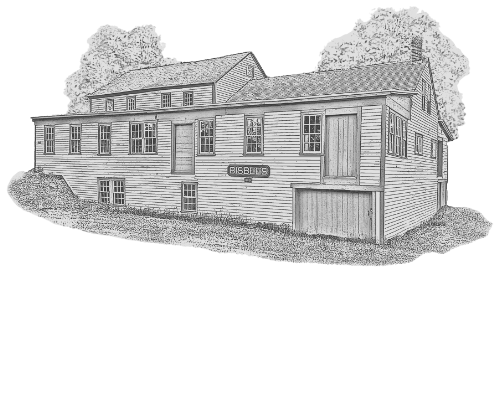
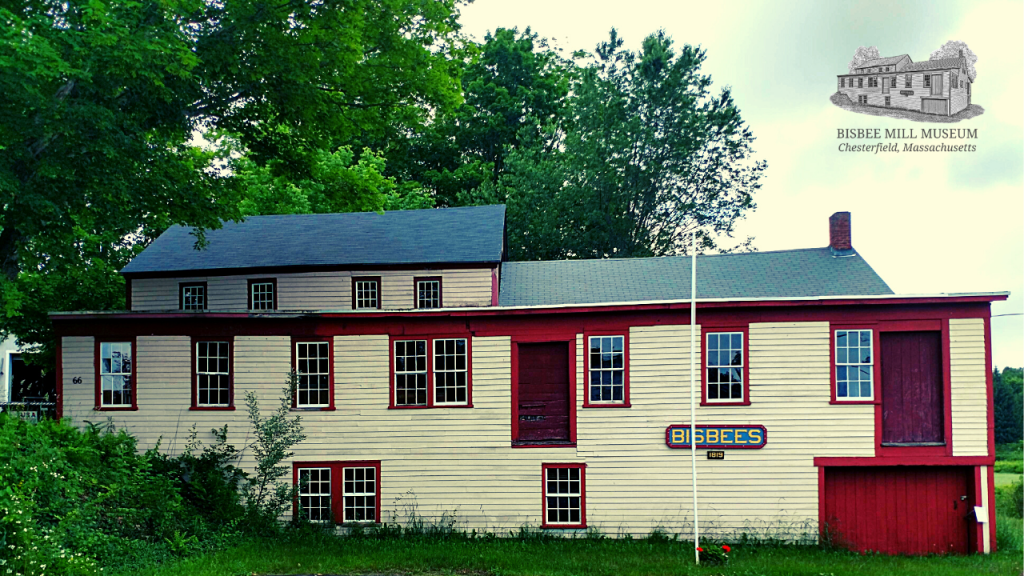
At the bottom of Bofat Hill in Chesterfield, Massachusetts, nestled against a bank near the Dead Branch, is a building with a remarkable history. Parts of it have been there for 200 years. Over that time, it has served many purposes. Today it’s known as the Bisbee Mill Museum and houses a treasure of history, not the least of which is the building itself.
Elisha Bisbee purchased a sawmill and corn mill from Benjamin Pierce here in 1819. Over the next decade he built the first section of the present-day museum, built the canal and the “Upper Pond,” visible from Route 143. The mill pond on Bisbee Road was built later and served a sawmill located on the east side of the river.
Ownership of the mill passed from Elisha Bisbee to his sons Osman and Orin beginning in the 1830s. In the 1850s the east central section of the mill was constructed and the grist mill was rebuilt in this new portion. In addition to grinding corn, the wood shop turned out wagon wheels, broom handles, axe handles, ox yokes, caskets and other wooden pieces. A small blacksmith shop was added to forge hardware. In the 1870’s the southwest section was added on and in 1887 the property was deeded to Horatio Bisbee
One of the most important pieces produced at the museum was whip butts. Westfield, MA was known as the Whip City and was the world’s largest manufacturer of buggy whips. Inside the handle, or butt end, of a buggy whip was a block of wood cut to a particular size and shape depending on the size of the whip. These wooden whip butts were made here by the thousands and shipped to Westfield.
In 1888 production expanded and the southeast section was added. The property was deeded to Charles A. Bisbee Sr. and Homer Bisbee in 1918 and the following year and new state of the art water turbine was installed. With the advent of the automobile, demand for buggy whips began falling and the business turned to other wooden products. A decade later electricity arrived and the water turbine and 1400 feet of canal were discarded in favor of electricity. A single motor was installed to run the existing flat-belt driven equipment.
The grist mill ceased operation around the same time as electrification. The mill shifted to specialty molding and decorative wood until closing around 1960. After that, it served as a lumber warehouse until Bisbee Brothers closed in 1991. After that, the building was turned into a museum and donated to the Historical Society.
Today, the former gristmill is dedicated to preserving Chesterfield’s history of farming and manufacturing. Along one side of the museum is a display of maple sugaring equipment. In the back corner is a horse drawn hearse along with a casket made here. Several different styles of horse drawn plows line the back wall. The whip butt cutting equipment is presented as well. Upstairs in the wood shop is a belt driven lathe, drill press and jigsaw along with the tools for building wagon wheels. The blacksmith shop is there too, with a small forge and anvil. Down stairs, on the ground floor is the 1919 water turbine and all the wooden pulleys to run the equipment.
The museum is open on a monthly basis during the spring, summer and fall. A group of dedicated volunteers run the gristmill, powered these days, by a 1927 Hercules One-Lunger engine. Other volunteers are on hand for guided tours to answer any questions.
 Bisbee Mill Museum © 2021-2025