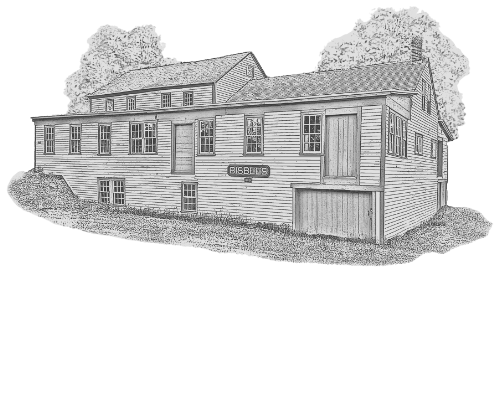
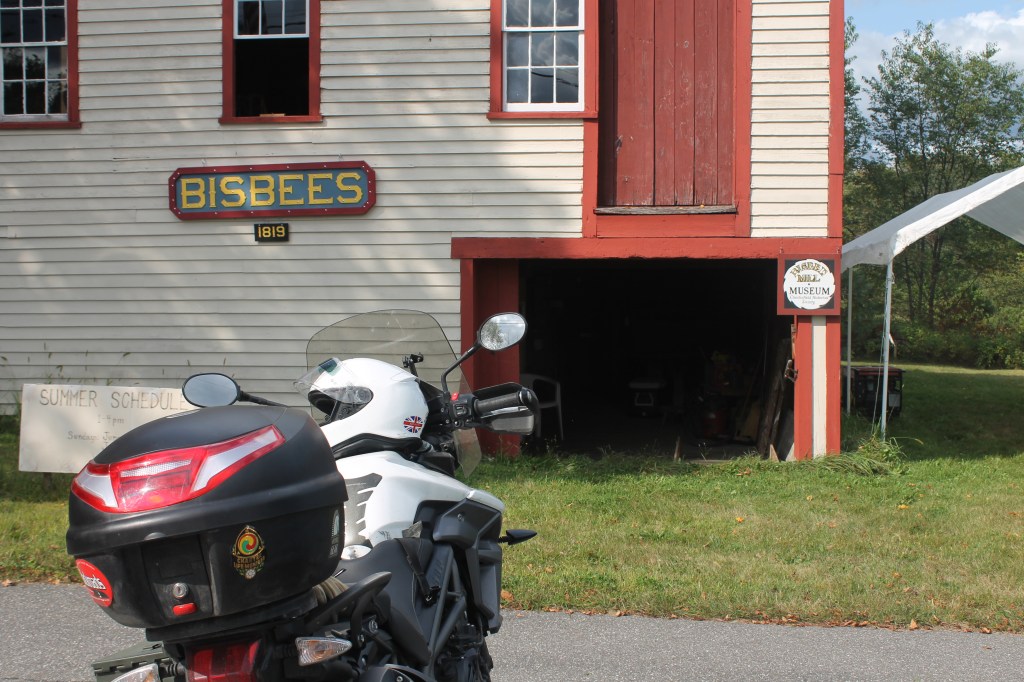
During last year’s Summer Squeeze rally in Vermont I led a group of riders to the town where I grew up. Two centuries ago my great-great-great grandfather operated a gristmill in the small town of Chesterfield Massachusetts. Chesterfield is a rural town in the Berkshire hills and even now, the population barely cracks 1000. The neighborhood where I grew up and learned to ride my first motorcycle has changed some. The sawmill has closed along with my Dad’s hardware store and my uncle’s dairy farm. The big old building we simply called “the shop” is still there, but now it’s on the National Register of Historic Places and houses the Bisbee Mill Museum.
It was 1819 when Elisha Bisbee bought the water rights on a small stream in a small valley west of the Connecticut River. Back then, industrial power was provided by falling water and water rights were the key to that power. Drop and flow were the two things that determined how much power you had. While neither the drop nor the flow at this site were not exceptional, it was enough to power a gristmill. Elisha enlarged the existing gristmill and built a mill pond and a 1400 foot canal to provide more drop and thus, more power to the mill. By closing off the water in the evening and letting the pond fill, there was enough water to run the mill during the day. This worked well and the mill expanded to include a woodworking shop. In addition to grinding grain, the shop produced wooden product of the day including wagons and wagon wheels, tool handles, caskets and whip butts.
In 1919, the water wheel was replaced with a new state-of-the-art cast iron vertical axis water turbine to provide power. Electricity arrived a decade later and that state-of-the-art turbine was quickly abandoned in favor of electric power. As the mill was already configured to run off a central power source, a single 20 horsepower motor replaced the turbine and operated the existing belt driven equipment. However, with the arrival of electricity, water rights lost much of their value and business at the mill suffered.
The gristmill ceased operation around the time of electrification while the woodworking shop continued making specialty molding and tool handles before closing for good in 1960. For the next 30 years the building was used for storage. In 1990, it was donated to the town historical society and refurbished as an agricultural museum. The gristmill was put back into operation and much of the belt-drive power system was rebuilt. Instead of water power or that 20 horsepower motor, the mill was configured to run off a 7 horsepower hit-and-miss “one lunger” engine. Today, the mill is open to the public monthly during the summer.
When visiting the museum, you enter on the ground floor, stepping back in time. The first thing you see is the 1919 cast iron water turbine sitting in its original location. The canal feeding it has been partially filled in so the turbine sits in a mostly dry stone lined water tub. Around to the left is the main the drive system. There are multiple line shafts with different sized pulleys to produce different speeds for the equipment that used to be upstairs. The wooden pulleys range in size up to four feet in diameter. Over to the other side of the turbine, you can climb a set of stairs to the main floor of the museum.
At the top of the steps is the grindstone. When it’s running, corn is conveyed up through the ceiling where it dumps down a chute into a hole in the center of the grindstones. The “runner” stone turns while the “bed” stone remains stationary. The gap between the stones can be adjusted to change the coarseness of the corn meal. Crushed corn meal drops out around the circumference of the millstones.
The rest of the main floor is an agricultural museum dedicated farming and local trades. There are some hand crank pieces of equipment for winnowing grain used for separating the wheat from the chaff. There is also a hand cranked corn shucker that removes the kernels of corn from the cob. Along the back wall of the mill is a collection of horse drawn plows.
In the back corner of the museum is a horse drawn hearse. My grandfather and my uncle were undertakers and ran the Bisbee Funeral Home until the mid 1980s. There is also a casket on display that was made here at the mill.
In the 1800s, maple syrup was used as a general purpose sweetener and many farmers in this area made maple syrup. My brother and I still do. Holes were drilled into maple trees in the spring and wooden spouts were pounded into the holes. A wooden bucket hung beneath the tap. Sap was collected and boiled down into maple syrup and maple sugar over a wood fire. Some wooden buckets made here at the mill are on display as well as a couple of wooden sap tanks. There is also a small machine for turning the wooden spouts. It is designed to run off a flat belt drive and was very likely used here at the mill.
Against another wall is an exhibit from the Bisbees Post Office. Around the turn of the 20th century, a US Post Office operated out of my great grandfather’s home and the sign and delivery boxes are on display.
Warren Brisbois was a local butcher and many of his tools are on display. His son Jim and his wife Kathy, my cousin, along with his grandchildren Shannon and Jeremy and Jeremy’s family are the volunteers who keep the museum operating.
Up on the third floor of the museum is a small blacksmith shop. I’m not sure who thought putting forging equipment on the third floor of a wooden building was a good idea. The blacksmith shop may have produced the metal rims for wagon wheels, but judging by its size and location, was mainly used to build and repair metal work around the mill.
The other half of the upper floor is a woodworking shop. Here, a drill press and lathe are still connected to the belt drive system two stories below. Equipment used to make wagon wheels is on display has well. The hubs were turned on the lathe and then drilled to accept the spokes. The hubs were then set into a fixture and the spokes were added. Another machine was used to shape the outer wooden hoop. After all the pieces are assembled, a metal ring from the blacksmith shop was heated and slipped over the whole assemble to provide strength and durability.
Before leaving, I ventured out back where the one-lunger sat, chuffing away running the gristmill. It’s a 1929 Hercules engine rated at 7 horsepower at 825 rpm. It produces these 7 horsepower with around 1950ccs of engine displacement. My motorcycle, which benefits from an extra 86 years of development, produces around 100 hp from 800 ccs. In another 86 years though, I bet the one-lunger has a better chance of still running.
 Bisbee Mill Museum © 2021-2025